How and why a global vision could prevent or stop the next world war
History shows that major conflicts rarely arise solely from ideologies. Often, it is economic insecurity, resource scarcity, social inequality, and geopolitical power struggles that cause tensions to escalate.
In the 21st century, humanity faces a crucial question:
Can a shared global vision become stronger than national competition?
Perhaps therein lies the key to preventing future world wars or stopping ongoing wars.
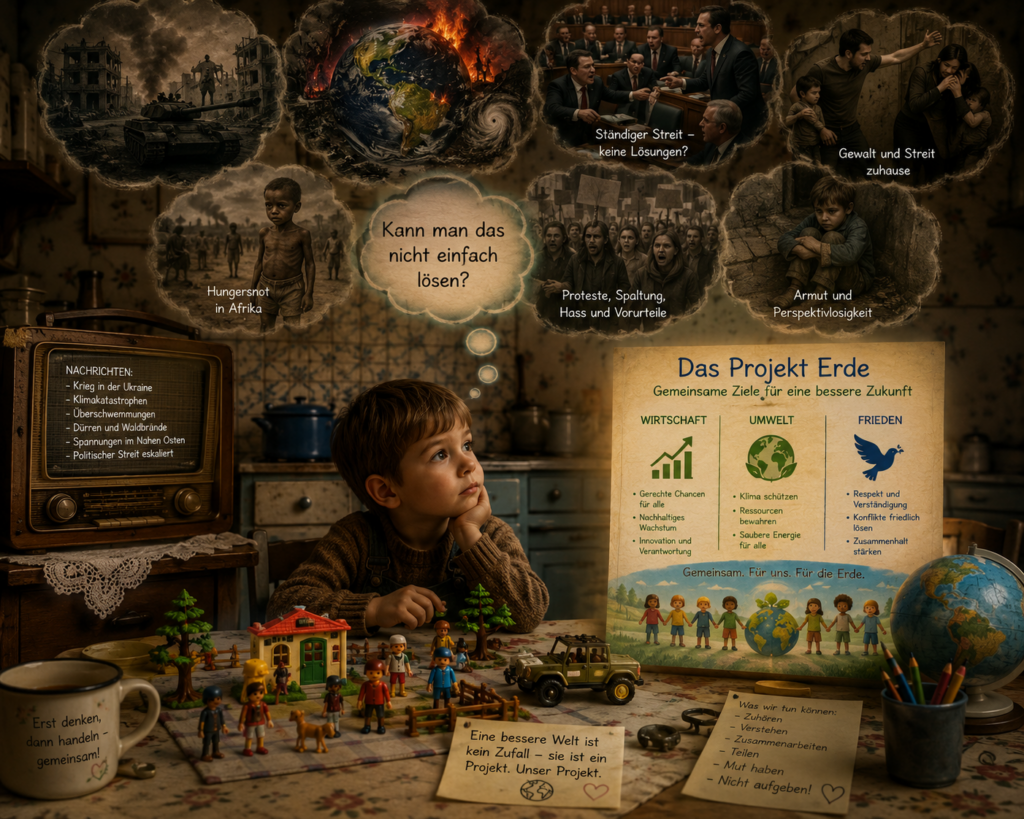
The Earth as a shared project
Climate change, energy supply, migration, inflation, and social inequality are no longer issues that affect only individual countries. The problems have become global—yet many solutions are still conceived at the national level.
When states no longer operate economically solely in opposition to one another but instead pursue shared goals, the dynamics change:
- fewer resource wars
- reduced economic dependencies
- more shared infrastructure
- greater stability through cooperation
A world working together on progress, freedom, and security has less interest in destruction.
Reducing global warming as a peace project
Combating global warming is often viewed merely as an environmental issue. In fact, it is also a security issue.
Rising temperatures lead to:
- Water scarcity
- Crop failures
- Displacement flows
- economic crises
- social tensions
The more regions are destabilized, the greater the risk of international conflicts becomes.
A shared ecological course, on the other hand, could create new markets and jobs worldwide:
- Expansion of renewable energy
- global research collaborations
- sustainable infrastructure
- low-emission industry
- new mobility concepts
This creates not only climate protection but also economic prospects.
Fair global trade instead of global exploitation
Many tensions arise from extreme economic imbalances. While some countries reap enormous gains, others remain trapped in poverty, dependency, or unstable employment conditions.
Fairer global trade could mean:
- fairer wages
- better working conditions
- transparent supply chains
- Investments in education and infrastructure
- less exploitation of cheap labor
If people worldwide are given a realistic chance of stability and prosperity, their susceptibility to extremism, violence, and political radicalization will also decrease in the long term.
Economic dignity is often an underestimated factor for peace.
Why fairer wages promote global stability
A global problem is the increasing concentration of wealth among a few actors, while at the same time millions of people—despite working—can barely meet their basic needs.
This generates frustration, uncertainty, and social tensions.
A global vision could therefore also include:
- living wages
- better educational opportunities
- Access to healthcare
- stronger social security systems
- Support for small and medium-sized enterprises
People who have prospects rarely fight against each other.
People without hope, on the other hand, become more easily manipulable—politically, economically, and ideologically.
A shared vision instead of collective competition
Maybe the world needs fewer systems working against each other — and more shared visions of the future.
A global vision could be:
Economic success must no longer be achieved at the expense of people, the environment, and peace.
Shared goals could emerge from this:
- technological innovation for all
- sustainable prosperity
- international research alliances
- climate-neutral economy
- fair trade relations
- stable social systems
- Education as a global fundamental right
Humanity would thus have, for the first time, a shared project that transcends individual political camps or economic power interests.
Peace is achieved not only through the military, but through mutual agreements.
Many states invest billions in defense. Yet long-term peace rarely arises from deterrence alone.
Peace arises where:
- People have perspectives
- Resources are distributed equitably.
- Economic stability exists.
- Cooperation becomes more attractive than conflict.
The true challenge of our time might therefore be not merely technological or political—but cultural:
Will humanity manage to shift from a logic of competition to a logic of cooperation?
Mastering the AI Industrial Revolution
This, too, is a key focus: optimizing industry, regulating the opportunities and risks associated with the use of artificial intelligence and robotics, and exchanging information on research and development. Creating common ground rather than division and polarization.
Conclusion
A shared ecological and economic vision could be far more than a political ideal. It could become the foundation for global stability.
For when states together:
- reduce global warming,
- promote fair trade,
- reduce social inequality
- mastering the technological AI and industrial revolution
- and build sustainable prosperity,
Then, instead of dependency born of fear, a connection based on shared interests emerges.
Perhaps that is precisely the most important peace strategy of the 21st century.